





arcjetCV
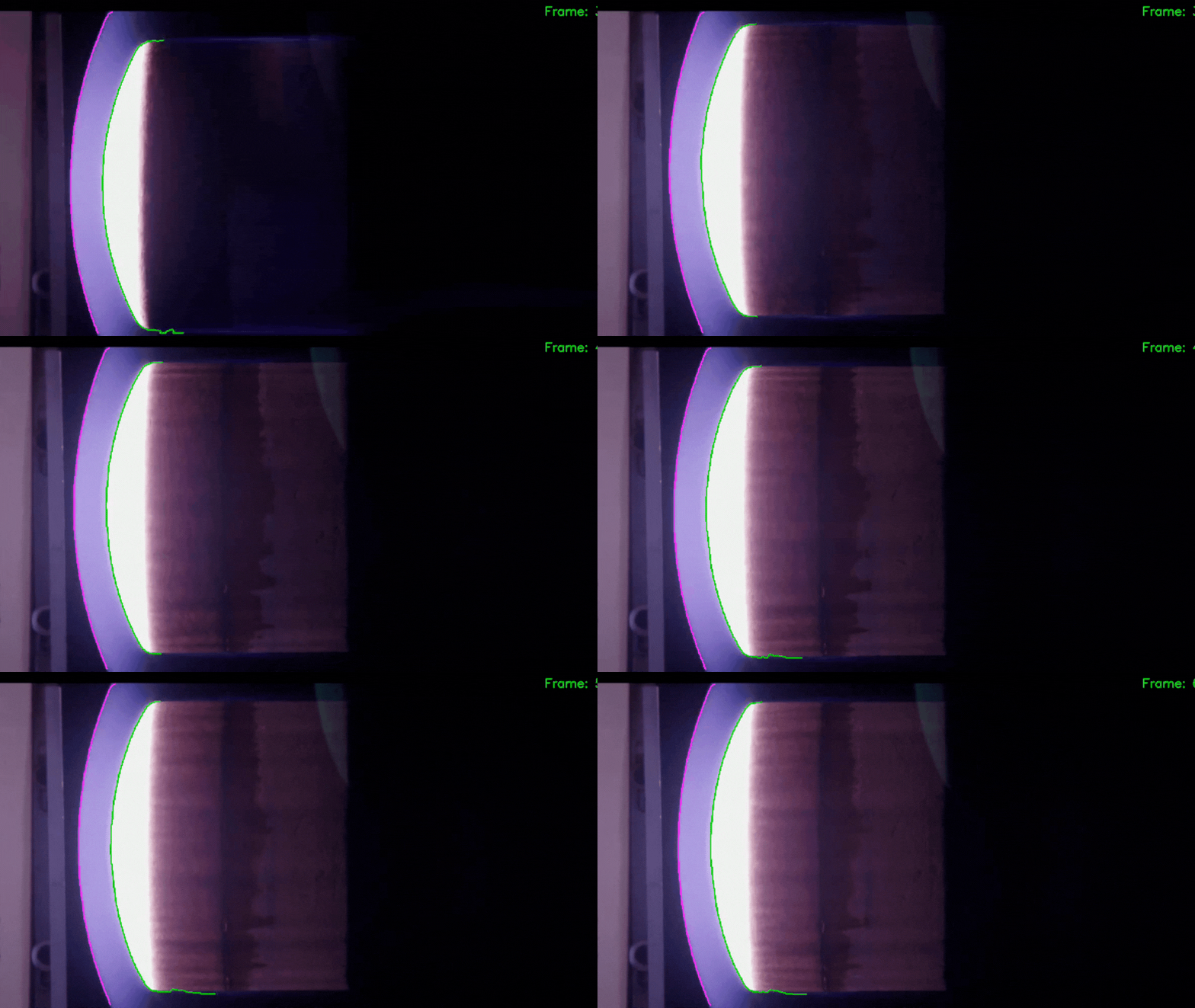
Package to process arcjet videos and segment the edge of the shock and of the sample.
Installation
PyPi Installation (Universal)
Prerequisites:
Ensure you have Python 3.8 or higher installed.
To install arcjetCV via pip from PyPi, run:
pip install arcjetCV
This will install arcjetCV along with its dependencies.
Note for macOS Users:
You might need to install Xcode Command Line Tools:
xcode-select --install
Note for Linux Users:
You may need to install libxcb-cursor. Use your package manager to install it:
For Ubuntu/Debian-based distributions:
sudo apt-get install libxcb-cursor0
For Fedora:
sudo dnf install libxcb-cursor
For Arch Linux:
sudo pacman -S libxcb
Developer Installation
Prerequisites:
A valid git installation.
Miniconda or Anaconda for environment and package management:
For macOS users, make sure the Xcode Command Line Tools are installed:
xcode-select --install
To install arcjetCV for development, follow these steps:
Install
git-lfs:Download and install it from here.
Clone the repository and install the package:
git clone https://github.com/magnus-haw/arcjetCV.git
cd arcjetCV

# CPU environment (recommended default)
conda env create -f env/arcjetCV_env_cpu.yml

# GPU environment (NVIDIA GPU + CUDA required)
# conda env create -f env/arcjetCV_env_gpu.yml

conda activate arcjetcv
python -m pip install -e .
The -e flag stands for ‘editable’ and means that any changes to the local source code will immediately affect the arcjetCV package and GUI.
Choose the environment file based on your hardware:
env/arcjetCV_env_cpu.yml: works on any machine (recommended default).env/arcjetCV_env_gpu.yml: use this only when you have a compatible NVIDIA GPU and drivers/CUDA stack configured.
How to Run
PyPI Users
Launch the GUI:
arcjetcv
Developer Users
Activate your conda environment first:
conda activate arcjetcv
Then launch the GUI:
arcjetcv
Or use arcjetCV’s Python API inside a Python script, e.g., test.py:
import arcjetCV as arcv
video = arcv.Video("tests/arcjet_test.mp4")
Run the script with:
python test.py
Citing
If you use arcjetCV in your research, please use the following BibTeX entry to cite our paper:
@article{doi:10.2514/1.A36132,
author = {Quintart, Alexandre M. and Haw, Magnus A. and Semeraro, Federico},
title = {arcjetCV: Open-Source Software to Analyze Material Ablation},
journal = {Journal of Spacecraft and Rockets},
volume = {62},
number = {5},
pages = {1644-1653},
year = {2025},
doi = {10.2514/1.A36132},
URL = {https://doi.org/10.2514/1.A36132},
eprint = {https://doi.org/10.2514/1.A36132},
abstract = { ArcjetCV is an open-source Python software designed to automate time-resolved measurements of heat shield material ablation and recession rates from arcjet test video footage. This new automated and accessible capability enables two-dimensional in situ recession characterization from profile video. ArcjetCV automates the video segmentation process using two primary machine-learning models: a one-dimensional (1D) Convolutional Neural Network (CNN) to infer the time window of interest and a two-dimensional CNN for image segmentation. A graphical user interface simplifies the user experience and an application programming interface allows users to call the core functions from scripts, enabling batch video processing. ArcjetCV’s capability to measure time-resolved recession the enables characterization of nonlinear processes (nonlinear recession, shrinkage, swelling, etc.), contributing to higher-fidelity validation and improved modeling of heat shield material performance. The source code associated with this paper can be found at https://github.com/magnus-haw/arcjetCV. }}
Legal / License
Copyright © 2024 United States Government as represented by the Administrator of the National Aeronautics and Space Administration. All Rights Reserved.
Disclaimers
No Warranty: THE SUBJECT SOFTWARE IS PROVIDED “AS IS” WITHOUT ANY WARRANTY OF ANY KIND, EITHER EXPRESSED, IMPLIED, OR STATUTORY, INCLUDING, BUT NOT LIMITED TO, ANY WARRANTY THAT THE SUBJECT SOFTWARE WILL CONFORM TO SPECIFICATIONS, ANY IMPLIED WARRANTIES OF MERCHANTABILITY, FITNESS FOR A PARTICULAR PURPOSE, OR FREEDOM FROM INFRINGEMENT, ANY WARRANTY THAT THE SUBJECT SOFTWARE WILL BE ERROR FREE, OR ANY WARRANTY THAT DOCUMENTATION, IF PROVIDED, WILL CONFORM TO THE SUBJECT SOFTWARE. THIS AGREEMENT DOES NOT, IN ANY MANNER, CONSTITUTE AN ENDORSEMENT BY GOVERNMENT AGENCY OR ANY PRIOR RECIPIENT OF ANY RESULTS, RESULTING DESIGNS, HARDWARE, SOFTWARE PRODUCTS OR ANY OTHER APPLICATIONS RESULTING FROM USE OF THE SUBJECT SOFTWARE. FURTHER, GOVERNMENT AGENCY DISCLAIMS ALL WARRANTIES AND LIABILITIES REGARDING THIRD-PARTY SOFTWARE, IF PRESENT IN THE ORIGINAL SOFTWARE, AND DISTRIBUTES IT “AS IS.”
Waiver and Indemnity: RECIPIENT AGREES TO WAIVE ANY AND ALL CLAIMS AGAINST THE UNITED STATES GOVERNMENT, ITS CONTRACTORS AND SUBCONTRACTORS, AS WELL AS ANY PRIOR RECIPIENT. IF RECIPIENT’S USE OF THE SUBJECT SOFTWARE RESULTS IN ANY LIABILITIES, DEMANDS, DAMAGES, EXPENSES OR LOSSES ARISING FROM SUCH USE, INCLUDING ANY DAMAGES FROM PRODUCTS BASED ON, OR RESULTING FROM, RECIPIENT’S USE OF THE SUBJECT SOFTWARE, RECIPIENT SHALL INDEMNIFY AND HOLD HARMLESS THE UNITED STATES GOVERNMENT, ITS CONTRACTORS AND SUBCONTRACTORS, AS WELL AS ANY PRIOR RECIPIENT, TO THE EXTENT PERMITTED BY LAW. RECIPIENT’S SOLE REMEDY FOR ANY SUCH MATTER SHALL BE THE IMMEDIATE, UNILATERAL TERMINATION OF THIS AGREEMENT.